

Making the Most Out of Your Supply Chain Resources
MyEducator has a vast catalog, ranging from Accounting Software Systems to Workforce Planning: Recruitment and Selection. Among these resources is the Supply Chain series, covering topics ranging from supply chain basics in the Introduction to Supply Chain Management resource to more specifics such as Sustainability and Risk or Global Supply Chain.

To introduce students to the world of the supply chain, MyEducator has four introductory textbooks: Operations and Supply Chain Management, Logistics Management, Purchasing and Supply Chain, and Introduction to Supply Chain Management, which covers the basics of the first three. Each of these resources is meant to help prepare students to enter the business world.
Staying Relevant in an AI World
With the introduction of AI into the business world, there are many people, from students to instructors to real-world practitioners, who are wondering how AI will affect the world of supply chain. What will AI replace? What will AI enhance? And where will the human touch be essential? These are questions with answers that are ever evolving.
The authors of MyEducator’s supply chain resources believe that the human touch is still, and will always be, important to global organizations. Traditional and quantitative analysis—the analysis that AI is most often used for—will only get a company part of the way to full success. Practitioner-led, qualitative analysis is important for closing that gap.
The value of this type of analysis is why MyEducator offers free access to the Supply Chain Concepts and Cases resource for all instructors and their students who adopt any of the four introductory supply chain resources. This resource can also be adopted on its own, for those interested.
Supply Chain Concepts and Cases
The Supply Chain Concepts and Cases resource starts with an introductory chapter titled “How to Build a Supply Chain Champion.” What follows are six modules covering six of the basic elements of supply chain: Planning, Sourcing, Making, Delivering, Returning, and Enabling (formerly known as the SCOR model).
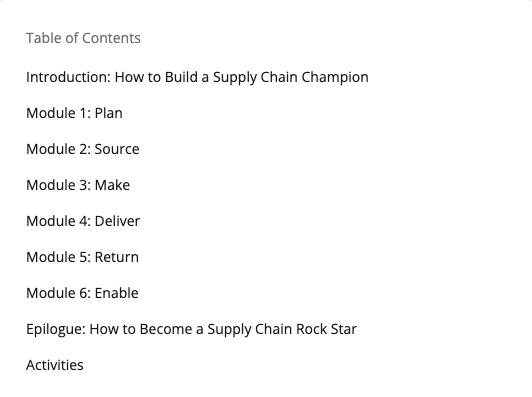
Each module includes 3–6 case options instructors can provide for students to do their own analysis. Beyond this, the Supply Chain Concepts and Cases resource seeks to ensure that it includes current cases. This range allows professors to pick and choose which cases will work best for their own course syllabus and lesson plans. Additionally, while no cases will ever be removed from the book—as even older cases teach fundamental principles—the authors add more cases as the world changes and develops. These updated cases are available to anyone, both instructor and student, who has used the resource at any time, as students have lifetime access, and older resources can be updated instantly.
Many of the cases within this resource are built around real-life examples from companies including Whirlpool, Amer Sports, and Walmart. These cases allow students to examine real-world scenarios, analyze the expressed problems, and workshop their own solutions.
The Supply Chain Concepts and Cases resource is not a traditional textbook; it is meant to work alongside and enhance a student’s learning experience. Instructors can use this resource to help their students gain the skills they will need to stay relevant in a world being changed by AI.